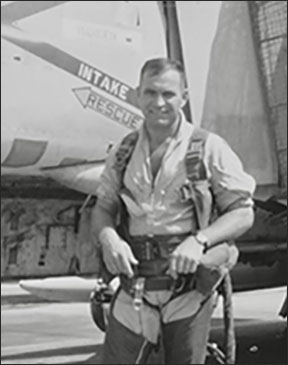
It is my sad duty to inform you that on the morning of Thursday, 26 February 2026, Golden Eagle Emeritus LtCol David G. DREWELOW, USMC (Ret) made his Last Take Off at home in La Jolla, California. Dave was 91 years old.
Dave was born and raised on a ranch in central Oregon, near the city of Prineville. He was a free-spirited cowboy, who chose to quit high school in the fall of 1951 in order to enlist in the U.S. Marine Corps and fight in the Korean War. After gaining his parents approval, he enlisted in the Marines in January 1952 with three friends, seeking orders to Korea. After being disappointed with orders to Barstow, California, he had a request mast with his CO to have his orders changed that was denied. Dave opted to return to the cowboy life back home. That plan resulted in disciplinary action but was successful in that he got his orders to Korea. Arriving in Korea in January 1953, Dave reported to Alpha Company, 1st Marines, 1st Squadron as a Browning Automatic Rifleman. He was wounded in action in an ambush while on a night patrol and left Korea in January 1954 to report for guard duty at Indian Island Naval Ammunition Depot (near Bremerton, Washington). That duty station was close to a U.S. Naval Hospital where he continued to be treated for his wounds.
Dave was discharged from active duty in January 1955 but did join the Marine active reserves the following month where the $50/month pay was a welcome addition as he returned to the cowboy life at the ranch in Oregon, and where he became a rodeo rider. Riding broncos, he ended up breaking his neck, and could not work for a period of time, so elected to go to college, at Lewis & Clark College in Portland, Oregon. While there, he met his future wife and love of his life, Alice. Still in the reserves, he also began officer training, receiving the Commandants Leadership trophy for demonstrated skills, and ranking 3rd of 659 in his class. Graduating from Lewis & Clark in June 1959, Dave was commissioned in the U.S. Marine Corps, married Alice in August, and started on the path to flight training.
In flight training Dave flew the T-34 Mentor, the T-28 Trojan, the F-9 Cougar, and the F-11 Tiger. Surviving a low altitude ejection in the F-11, Dave was awarded his Wings of Gold on 28 April 1961 and reported to his first operational squadron in June, VMF(AW)-114, flying the F4D Skyray at MCAS Cherry Point and then in Atsugi, Japan. With the squadron’s disestablishment in July 1963, Dave next reported to VT-23 in NAS Kingsville, Texas, as a flight instructor flying the F-11 and the F-9. Remarkably, while there he flew 111 hours in one month. Dave’s next assignment took him to Quantico as a student, but he managed to find time to assist VRF-31, an east coast ferry squadron located in Norfolk, Virginia, in ferrying aircraft as required.
In April 1967 Dave began transition training in the F-4 Phantom II and in June reported to VMFA-323 in Iwakuni, Japan, deploying to Chu Lai, Vietnam. In Chu Lai he flew the F-4 on strike missions and also flew the F-9 on Tactical Air Control Airborne (TACA) and Forward Air Controller Airborne (FACA) missions. In December 1967 he was sent TAD to HQ 7th Air Force in Saigon, a desk job, since he had flown too many missions. This did not sit well with Dave, so while in that billet he volunteered and flew backseat missions in U.S. Army bird dogs (Cessna L-19, later re-designated O-1) FACA missions and in the right seat of the C-1A Trader dropping flares for the Army. In April 1968, with an assist from fellow Golden Eagle Howard DECASTRO, Dave reported to VMFA-122 in DaNang, flying the F-4. Dave was awarded the Distinguished Flying Cross on one mission, where he provided air cover during the rescue of a downed aircraft aircrew. In July 1968 he transferred to MCAS Kaneohe, Hawaii, joining VMFA-235 flying the F-4. This tour was followed by transfer in November 1969 to the Air Station staff as the assistant safety officer and assistant operations officer. He continued flying the F-4, the C-45 Expeditor, and checked out in the UH-34 Seahorse becoming a SAR pilot. As pilot in command, he made a night rescue of a sailboat crew that had run aground near Kaneohe during a storm.
In November 1971 Dave transferred to Camp Lejeune, North Carolina, joining the 6th Marines as the Air Liaison Officer (ALO) and Forward Air Control (FAC) Officer. While this was a non-flying billet, he managed to find time on weekends to fly the F-4 with VMFAT-201. In November 1972 he was assigned to the Wing staff in Iwakuni, flying the F-4, RF-4, and the TA-4 Skyhawk. In March 1973 he reported to VMFA-232, Nam Phong, Thailand as the Operations officer, flying the F-4 on missions in Cambodia. While there he also served as the XO and acting CO for a period of time. In November 1973 he reported as XO of VMFA-531 at MCAS El Toro, California, once again flying the F-4. At the completion of this tour, he reported as Commanding Officer of Marine Air Base Squadron 11 (MABS-11) for an eighteen-month tour, flying the F-4 and serving as an instructor pilot as squadrons needed. In July 1976 he became the Commanding Officer of Headquarters and Maintenance Squadron 11 (HMS-11), where he continued to fly the F-4.
Dave’s next assignment was back to Quantico, in January 1978, where he became the Chief, Aviation Instruction Division. Recognizing that the opportunity for future flying billets was limited, Dave decided to retire from the U.S. Marine Corps in February 1979, completing a 27-year career that included three years as enlisted, four years in the reserves, and 20 years as a commissioned officer.
Dave’s career as a Marine took him from combat in Korea, as an infantryman, to combat in the skies over Vietnam and Cambodia as a Naval Aviator. In his 20 years of commissioned service, he accumulated 4,710 hours of flight time, flew 461 combat missions in two tours in Vietnam, and had 44 carrier arrested landings. His combat awards include the Distinguished Flying Cross, Strike/Flight Air Medal with the numeral 20, the Purple Heart and the Combat Action Ribbon. His aviation commands included one as acting CO in combat, and two as CO of units located at MCAS El Toro. His career was one of action, where he repeatedly requested stationing to deployed and combat engaged squadrons, and where he always seemed to find a way to fly, even if in a non-flying billet. Aviation — Marine Aviation, was in his blood.
After retirement, Dave first entered the telecom industry as a Manager but within two years decided that was not “his cup of tea.” In 1991 he began a two-year tour as the President and CEO of Quicksilver Enterprises Inc., at that time the world’s largest manufacturer and distributor of ultralight aircraft. As Dave put it, it was his last flying billet, and the transition from 500 to 50 knots was a bit of a challenge. He also was a consultant for the defense industry for over ten years, first designing an ACM defensive syllabus for the RF-4, and later working projects for the USN, USMC, USAF, RAF Harrier, F-20, MAWTS, and STRIKE U (as known at that time). Staying active, he joined Alice after her retirement from teaching, in leading tours to Mexico and Alaska for five years, and then for the next five years crewing for his son aboard a large motor yacht, sailing the world. As a longtime resident of La Jolla, California, Dave also spent over 16 years patrolling with the San Diego Police Department as a senior volunteer. Filling out the days, he and Alice enjoyed hiking, camping, sailing, skiing and bridge. Without question, Dave led an active and varied life, enjoying it to the fullest.
Dave is survived by his wife of 67 years, Alice, his two sons David and Richard, his daughter, Kelly, and four granddaughters. He was predeceased by his third son, Mark. Services are pending, and when known a special notice will be sent with that information.
He will be missed.
In sadness,
Marty CHANIK
Pilot
|